API error handling should address a specific problem. An integration failure appears as an empty component or a generic site error. A useful brief identifies the decision to make and the evidence needed to assess it.

Plan API error handling around the task
Design useful loading, failure and recovery states around the actual dependency. For website owners and delivery teams, the brief should explain what will be different for the person using or maintaining the implementation.
A realistic planning example
A shipping estimate explains temporary unavailability without presenting a fabricated delivery promise. Treat this as an illustrative scenario. The right response still depends on the audience, constraints and evidence available for your own project.
A practical review sequence
- Identify dependency failures. Use realistic material instead of an idealized placeholder, then note anything that becomes unclear.
- Explain usable alternatives. Check both the ordinary case and a less convenient variation so the rule is useful beyond the presentation.
- Avoid invented fallback data. Make the acceptance question specific enough that another person can repeat the review without guessing.
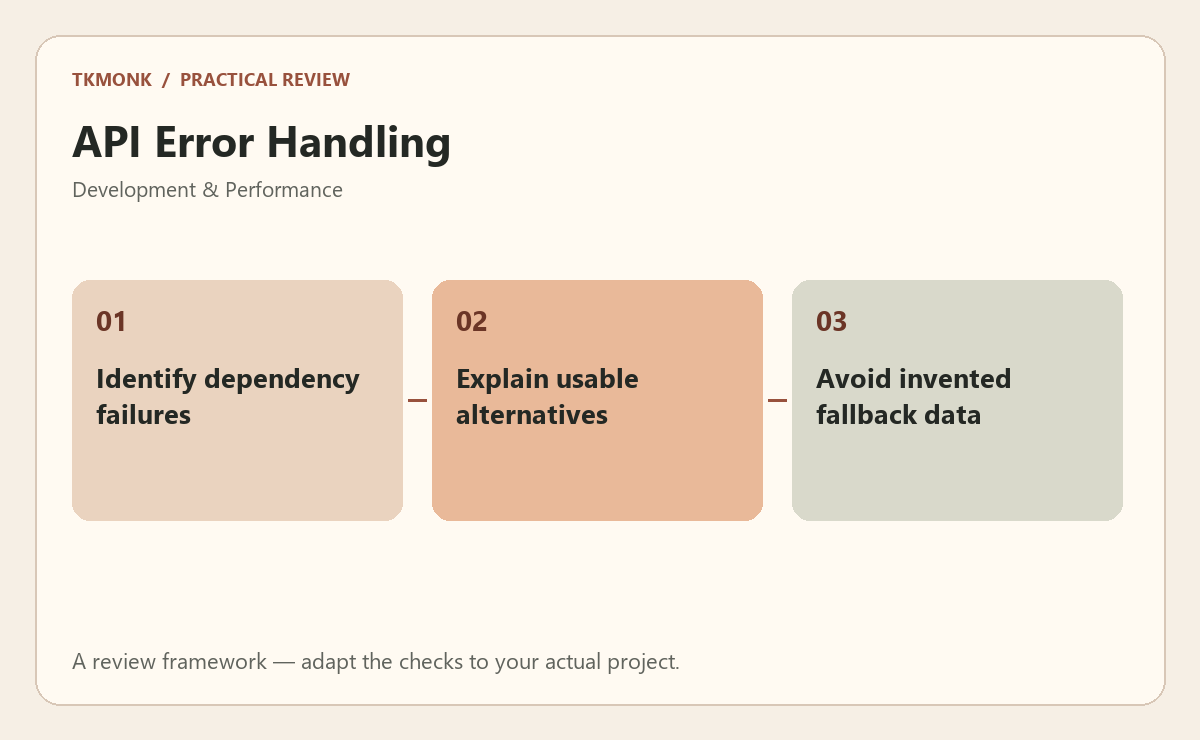
Check API error handling before approval
Use a reproducible test with recorded inputs to make the decision visible. Verify the behavior in an appropriate test environment before changing the live site. Include an ordinary successful journey and at least one failure condition. Record the environment and what was observed so another team member can repeat the check. A local result does not automatically establish production behavior.
A common mistake to avoid
Avoid treating one tool score or a successful screenshot as complete verification. Delivery depends on hosting, configuration, content and interactions working together. Investigate the specific problem before adding a new dependency or making a change that affects unrelated parts of the site.
Your next step
For API error handling, keep the review tied to the original problem. Use the website maintenance guide to prepare the wider brief, or explore web development services if you need help defining the work.
Further reading: Images course and WordPress security. These resources provide broader background; adapt the practical review to your specific situation.