Role based onboarding should address a specific problem. Every new account receives the same tour despite needing different tasks. A useful brief identifies the decision to make and the evidence needed to assess it.

Plan role based onboarding around the task
Ask only useful role questions and tailor the first meaningful action to that role. For product teams, the brief should explain what will be different for the person using or maintaining the interface.
A realistic planning example
A reporting viewer starts by locating a report, while an administrator starts by connecting a data source. Treat this as an illustrative scenario. The right response still depends on the audience, constraints and evidence available for your own project.
A practical review sequence
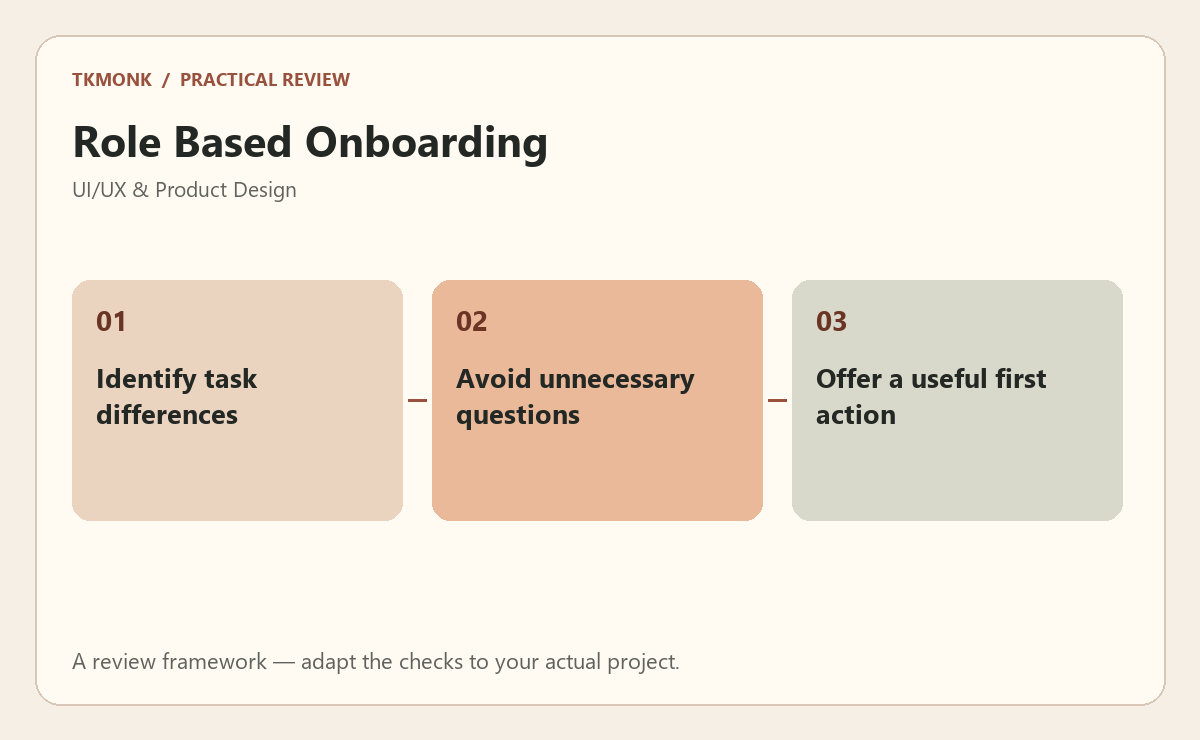
- Identify task differences. Review this in context with the surrounding information. An isolated component may behave differently in the complete journey.
- Avoid unnecessary questions. Retain a brief record of the approved choice and any remaining limitation so handoff does not turn uncertainty into a promise.
- Offer a useful first action. Write down what a reviewer should be able to confirm, and keep a concrete example beside the requirement.
Check role based onboarding before approval
Use a small prototype or annotated flow to make the decision visible. Ask someone familiar with the task to attempt it without coaching. Observe what they understand, where they hesitate and whether they recover after a mistake. Test relevant keyboard and narrow-screen behavior as part of that journey. A screen that looks convincing in a presentation still needs to make sense in use.
A common mistake to avoid
Avoid solving the issue through visual emphasis alone. A brighter button cannot repair an unclear permission boundary, missing recovery route or unsupported assumption. Record the intended behavior so design and implementation do not quietly diverge.
Your next step
For role based onboarding, keep the review tied to the original problem. Use design systems for small teams to prepare the wider brief, or explore interface and portal development if you need help defining the work.
Further reading: Structure tutorial and Tables tutorial. These resources provide broader background; adapt the practical review to your specific situation.