Third party script audits should address a specific problem. Embedded tools accumulate without a clear owner or purpose. A useful brief identifies the decision to make and the evidence needed to assess it.

Plan third party script audits around the task
Inventory third-party resources and evaluate their actual value and loading cost. For website owners and delivery teams, the brief should explain what will be different for the person using or maintaining the implementation.
A realistic planning example
A business checks whether an old campaign widget is still used before allowing it on every service page. Treat this as an illustrative scenario. The right response still depends on the audience, constraints and evidence available for your own project.
A practical review sequence
- List external resources. Review this in context with the surrounding information. An isolated component may behave differently in the complete journey.
- Assign a business owner. Retain a brief record of the approved choice and any remaining limitation so handoff does not turn uncertainty into a promise.
- Remove obsolete integrations. Write down what a reviewer should be able to confirm, and keep a concrete example beside the requirement.
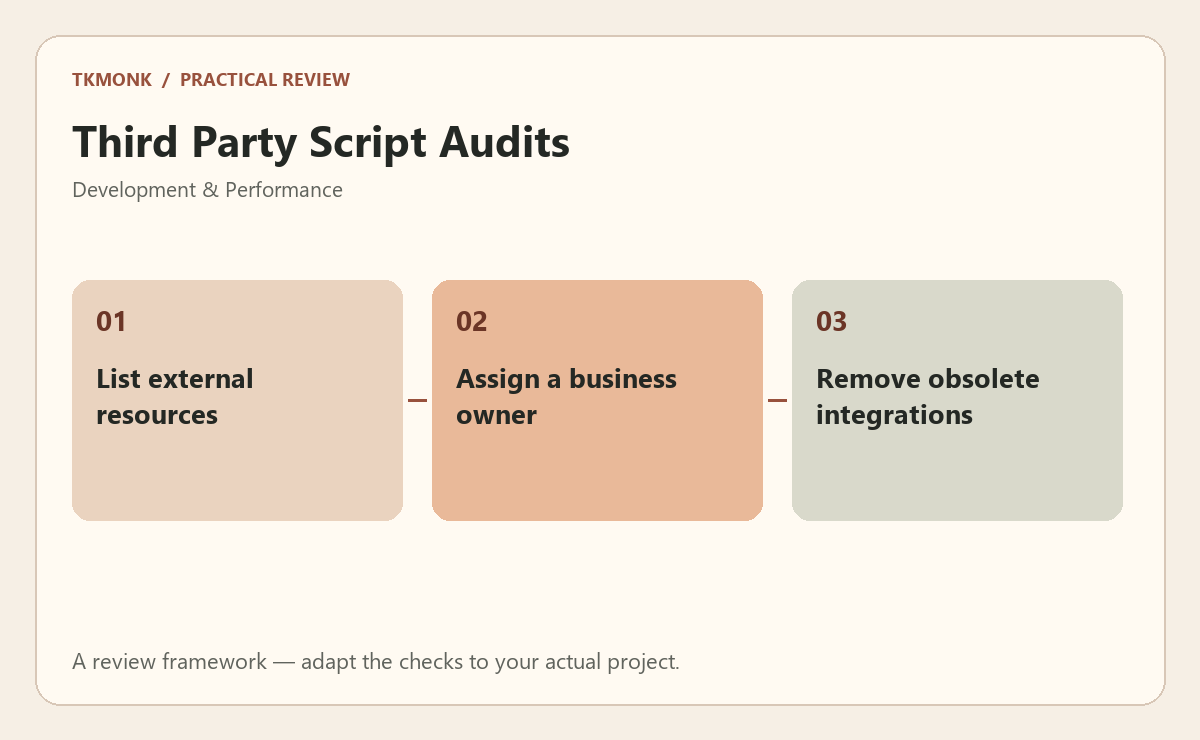
Check third party script audits before approval
Use a reproducible test with recorded inputs to make the decision visible. Verify the behavior in an appropriate test environment before changing the live site. Include an ordinary successful journey and at least one failure condition. Record the environment and what was observed so another team member can repeat the check. A local result does not automatically establish production behavior.
A common mistake to avoid
Avoid treating one tool score or a successful screenshot as complete verification. Delivery depends on hosting, configuration, content and interactions working together. Investigate the specific problem before adding a new dependency or making a change that affects unrelated parts of the site.
Your next step
For third party script audits, keep the review tied to the original problem. Use the website maintenance guide to prepare the wider brief, or explore web development services if you need help defining the work.
Further reading: Images course and WordPress security. These resources provide broader background; adapt the practical review to your specific situation.